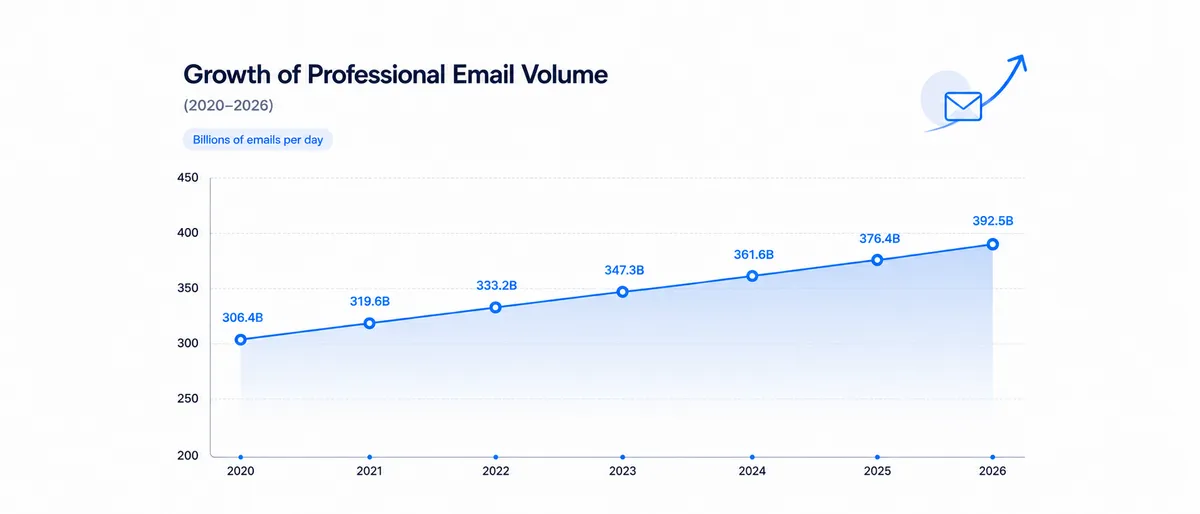
Global business email volume exceeded 361 billion messages per day in 2024, according to the Radicati Group Email Statistics Report 2024-2028, and is projected to surpass 424 billion by 2028. The tools that were supposed to reduce email dependency (instant messaging, collaborative platforms) largely added channels without removing existing ones. The result is a paradox: professionals have more ways to communicate than ever, and are spending more time managing email than ever.
Here is what the data shows about that paradox, and what it means in practice for teams that deal with clients, candidates, and prospects every day.
Context: email was supposed to die, it multiplied
From around 2016, a wave of collaboration tools (Slack, Microsoft Teams, Google Chat) promised to cut internal email volume dramatically. The argument was reasonable: internal conversations did not need to go through the inbox. For internal communications, the transition partially worked.
But external email, with clients, prospects, partners and candidates, did not follow that pattern. It kept growing, driven by the digitalisation of commercial relationships, the rise of outbound sales automation and the expansion of e-commerce. In 2020, the pandemic accelerated this further: remote-first work replaced in-person exchanges, and email remained the common denominator between organisations using different internal tools.
What the data shows
Per-person volume has never been higher
According to the Radicati Group, a business email user sends and receives an average of approximately 120 emails per day in 2024, up from roughly 100 in 2020. Even discounting automated and transactional messages, the net load per person has grown materially.
This average conceals significant variation by role. Customer-facing teams (support, sales, recruitment, account management) routinely handle between 150 and 300 messages per day, depending on company size and sector. For those teams, email is not a side channel: it is the primary workload.
Time spent on email has held steady above a quarter of the working week
The McKinsey Global Institute estimated in 2012 that knowledge workers spent 28% of their working week reading and writing email. An Adobe study published in 2019 confirmed this had not changed, with US professionals reporting spending more than 3 hours a day on work email alone.
What these figures demonstrate is the structural resilience of email as a workload. Productivity tools, collaboration platforms and time-management training have not produced a durable reduction in this number. The behaviour adapts to the tool, not the other way around.
Response time expectations are rising faster than response capacity
Customer and prospect expectations for email response time have tightened. According to research by Jeff Toister, who surveyed more than 3,200 consumers, 88% of customers expect a reply within one hour of sending an email to a business. The SuperOffice Customer Service Benchmark Report, which studied 1,000 companies, found the average company response time exceeded 12 hours.
This gap has widened as real-time digital communication became normalised. Consumers who use instant messaging daily no longer mentally file email in the “allow 48 hours” category. When they send a professional email, they expect a response in hours, not days.
What this means for professionals
These three trends converge on a single operational problem: customer-facing teams are under increasing volume pressure, without proportional growth in headcount or tooling.
For sales teams, every additional hour of delay in responding to a prospect reduces conversion probability. For support teams, a high average response time directly degrades customer satisfaction scores and generates follow-up messages that increase the volume further. For recruiters, a candidate who does not receive an acknowledgement within 48 hours has often already accepted another offer.
The solution is not longer hours or proportional hiring. It lies in standardising recurring responses, automatically prioritising incoming messages, and distributing emails intelligently across team members. Tools like Scribarius automate all three of these layers directly inside Gmail and Outlook, without migration or workflow change.
Conclusion
Business email volume will continue growing through 2027, driven by the expansion of digital commerce and the rise of automated outreach. The assumption that collaboration tools would reduce this load has not held for external communications.
What has changed is the availability of tools capable of absorbing this volume without increasing the load per agent. Teams that adapt earliest will hold a measurable responsiveness advantage. The organisations waiting for volume to stabilise on its own are waiting for something that the data consistently shows will not happen.
Tags