Bloomberg published an analysis yesterday that captures the current mood well: three years into the AI productivity promises, the evidence is finally accumulating. The verdict is nuanced. Gains are real, but they are not flowing where most companies expected. For professionals who manage high email volumes daily, the good news is that email is one of the few domains where studies consistently agree.
What the numbers actually show
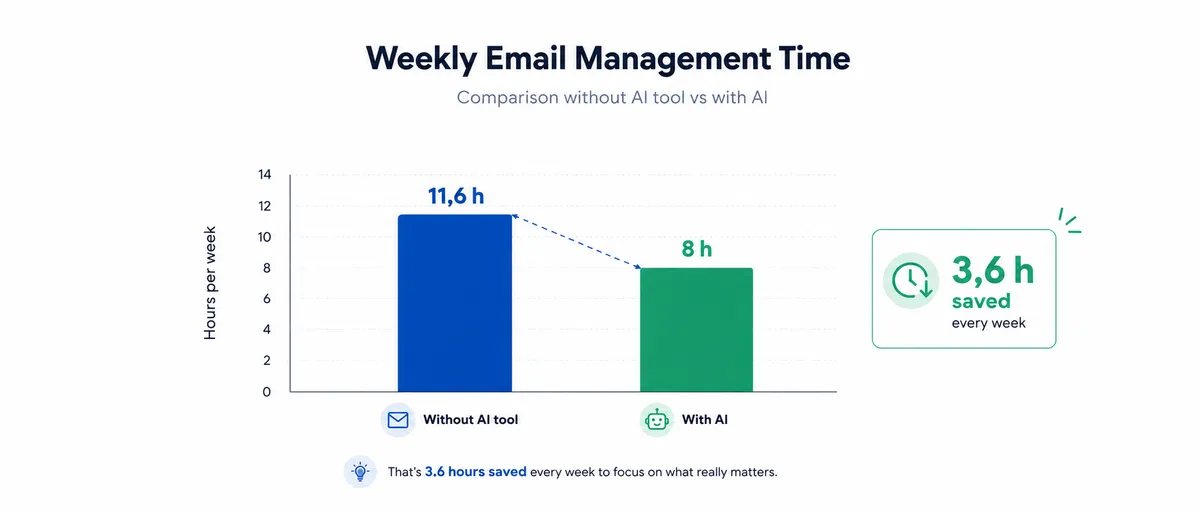
The most rigorous controlled studies point in the same direction for three task categories: writing, customer support, and software development. For writing, Noy and Zhang (2023) measured a 40% reduction in task completion time alongside an 18% improvement in output quality. On email specifically, a Microsoft Research and Harvard Business School study tracking 7,137 workers over six months found that regular AI tool users saved 3.6 hours per week on email management, a 31% reduction in total inbox time.
The PwC 2026 Global AI Jobs Barometer, covering more than one billion job postings across 27 countries, confirms the labour market is splitting into two paths: professionals who work with AI and those who do not. The productivity and wage gap between the two groups is widening fast.
These studies also reveal an asymmetric pattern. The workers who benefit most from AI are not always the most experienced, but those who had the weakest baseline skills in the relevant domain. In writing as in customer support, junior team members and non-native speakers tend to see the largest gains.
What this means for professionals managing their inbox
The data does not say AI makes everyone more productive at everything. It says AI accelerates tasks that are repetitive, structurable, and writing-heavy. Email fits that description precisely: responses to recurring requests, follow-ups, confirmations, internal updates, status messages.
What resists AI: negotiation, relationship management, strategic judgment. In other words, the real value of an experienced professional stays intact. What AI takes over is the surface volume: the dozens of messages that consume time without generating distinct value.
The nuance Bloomberg raises, and it is valid: this productivity does not distribute itself automatically. It requires adopting the right tools and integrating them into a real workflow, not attaching a chatbot outside your actual working context.
Scribarius is designed for exactly this: integrated directly inside Gmail and Outlook, it handles email volume without pulling you out of your existing workflow. GDPR-compliant by design, no data stored, built in Europe.
What to do now
- Measure the weekly time your team spends on repetitive emails: most professionals underestimate this figure by 30 to 40%.
- Test an email AI tool on one specific use case (follow-ups, acknowledgements, internal forwarding) before rolling it out across the entire inbox.
- Choose a tool that integrates with your existing email client: gains disappear if the tool requires you to leave your usual workflow.
The 3.6 hours saved per week add up to roughly 180 hours a year, more than a full month of work. That is where the advantage of teams who have made the switch becomes visible.
Try Scribarius free, no credit card required.
Tags